Veronica's Garden

Rachel Creager Ireland on writing, living, the Flint Hills, and the Post Rock Limestone Caryatids

Collectively Dreaming the Witch

What dark eyes haunt your dreams?

What dark eyes haunt your dreams?

Several months ago, the post “Dreams of Lots of Rooms” was getting hits. People were searching for just that, apparently. It came up on this blog’s list of search terms that brought people to Veronica’s Garden several times per week.

Lately it hasn’t, but now just as often people are searching for dreams of being chased by a witch, which I wrote about previously. In my dream, the witch who pursued me was a dark little girl, whom I recognized upon awaking as myself. Who is chasing you in your dreams? What wisdom is to be gleaned from this collective desperate evasion? What nightmare are we struggling to wake from, those of us anonymously searching the world brain for clues that might liberate our unconscious?

Let us speak our secret dreams. Let it begin here.

Clotho’s Loom: Weighty, Amusing, Mysterious, Difficult To Put Down

Clotho's Loom Cover

Sometimes a book is so weighty, and the ideas it contains so huge, that it’s hard to discuss. It would be like writing a blog post on world politics, or oceanography. It’s been two weeks since I finished Clotho’s Loom, and I don’t even know where to start writing about it. I’ll be honest, Shawn St. Jean and I are trading reviews of each others’ books, but I really was impressed by it and want to do it justice. (Besides, I read an excerpt before I agreed to read the whole thing, so I could tell it would be worth reading. Even so, I would never promise a positive review, only an honest one, which is what I would expect from any other author reading my own work.)

I guess I’ll start at the beginning. Will Wyrd has just turned 39, and he finds himself called inexplicably to military service, twenty years after his brief stint as a Marine. He has no taste for war, and his politics lean toward the liberal, in a wishy-washy way. He’s out of shape and a college professor. Certain that a mistake has been made, he reports to an anonymous office building to clear it up. Instead, he is given a date to report for duty, and instructed to tell his wife, Nexus, that he is enlisting by choice, rather than being conscripted.

I found the scenario amusing, the more so because the author himself is a college professor. I imagined the author was writing about himself, and not portraying himself in a particularly heroic way. But, interestingly, the point of view shifts between Will and Nexus, and St. Jean writes equally well about Will’s ambitious lawyer wife. Nexus struggles with Will’s obvious distraction, with navigating the maze of office politics, and with making the best choices for her unborn baby.

Clotho’s Loom isn’t light reading. We get a detailed look inside the minds of the two protagonists. Layers of complexity shift and dance. Is this an allegory of modern life? Is it a comment on modern relationships, or upon the inner masculine and feminine? Is the story absurd, or simple realism? It seems to be all these at once.

What can we glean, then about modern relationships? Will and Nexus are faithful to one another; they love one another; they care about each others’ needs; they have what most would consider a stable and healthy marriage. Yet there is a gap in their communication. They don’t appear to have other close relationships; they seemingly function as discrete bodies. Why doesn’t Will tell Nexus he’s going to go away? At the center of this choice is his late father, a veteran of Viet Nam. The man-to-man relationship takes priority over the marriage of a man and a woman. Even as Will struggles against the evaporation of other choices, he fails to make choices in his marriage, and this I found most troubling.

Nexus is left alone; but others step in and help. Some have ulterior motives; some appear to have greater-than-normal abilities. Who are these people taking such interest in an ordinary single mom-to-be? The various people who enter Nexus’s world are real and compelling, even as they are shown to be mysterious and perhaps supernatural. I didn’t quite get enough answers about some of the characters in Nexus’s story. Though I don’t think a book should have to answer every question, the mystery didn’t lead to greater depth; it just felt like either loose ends, or there was something I was supposed to get but didn’t.

Adding to the mystery, Will spends much of the latter half of the book in a series of vivid hallucinations. Just how much of what he experiences is real, we don’t know. The action in both stories accelerates, and as things heat up (heh heh- pun you won’t get until you read it),  the book becomes difficult to put down.

There’s so much more to this book. The geopolitics; the military as bureaucracy and tyrant; the ethics of war. But it’s late and if you’re willing to read another seven hundred words, you might as well just get the whole book and read it yourself. It’s really worth it. Most compelling and absorbing book I’ve read in a long time.

Go Read Jade Kerrion’s Blog (Author Spotlight on Rachel Creager Ireland)

Oh how exciting, Jade Kerrion has an Author Spotlight on me! She has a great blog and I’m very pleased to be there.

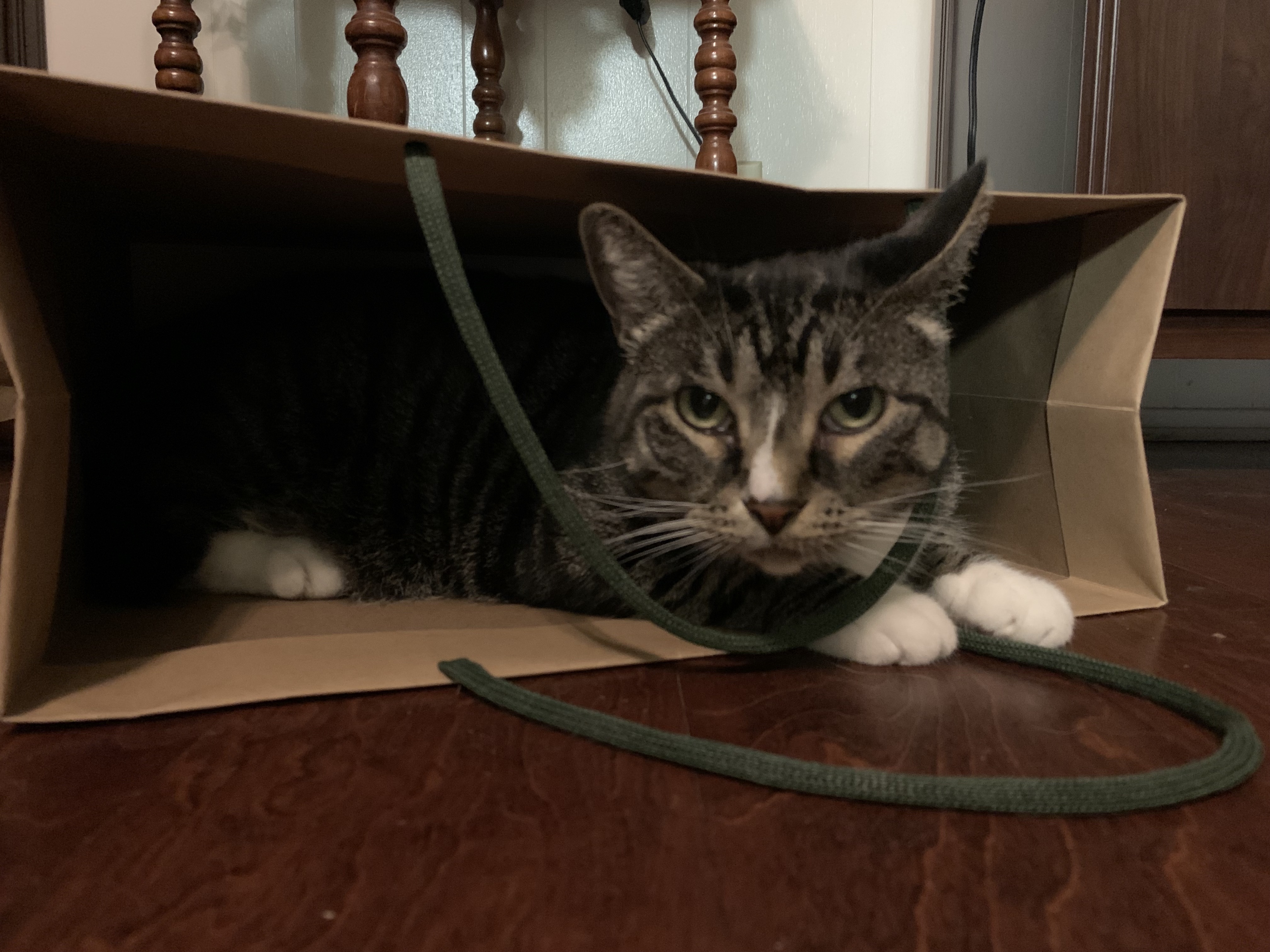
Here’s a random picture of a little girl with a cat.

Toulouse on Kiran

Turkey Vulture Shift Change

Reblogged from The Backdoor Artist:

  • Click to visit the original post
  • Click to visit the original post

What a treat today! I caught video of the parent turkey vultures during their shift change. We don't have sound from the nest, yet. We are working on getting the sound up.

Read more… 49 more words

For the turkey vulture lovers who frequent Veronica's Garden, we're reblogging Marya Livingston's The Backdoor Artist. She has a vulture-cam on a nest, which currently shelters two 3-week-old chicks. Visit the site for updates on the sweet little carrion-eating fluffballs.

Wasp As Totem, Another View

Animal totems are personal, and the complexities of each creature can teach us and assist us in different ways. I’ve shared my experiences and thoughts on wasp totem, but today I have some thoughts from my friend Mitra Ghaboussi, a person of diverse talents, including but not limited to shamanic healing and counseling, writing, and visual art. I asked her what she thinks about wasp totem, and this is what she said:

The wasp is a warrior and stands for decisiveness in war and business. Wasp is in nature’s business in the products they generate such as paper and so on. Wasp is industriousness as it works to feed itself and its young. Wasp is about not taking on too much but allying with the balance in nature. Anger is part of wasps message. Healthy anger is important and being aware of all your feelings.

When working with animal totems, if possible, watch your totem in its habitat. Notice what behaviors stand out, and look for how they can be related to yourself and your life. The defensive proctectiveness of wasp I wrote about previously was important to me at one time; for another person, one or more of the traits Mitra notes may be more relevant.

What experiences have you had with wasp? What message has wasp brought to you?

mushrooms

I asked for a wasp to shoot for this post, but apparently they didn’t want to come out on this gusty day. Who could blame them? All I could get were some blurry attempts at a black-capped chickadee, and these mushrooms, who obligingly stayed still, in one place, long enough for me to get a nice, close shot. Thanks, ‘shrooms.

Dandelion Syrup

Prairie Fire driveway

I have a strange way of gardening, which would surely drive most gardeners crazy. It turns out that, when you get to know them, a good number of weeds are edible, even wildly nutritious, if not downright medicinal. Hence, I don’t weed much. In fact, year after year, I get the best yield from the least interference with the ways the plants grow, whoever chooses to show up, whatever ways they are useful.

Sometimes it takes a while for me to discover their properties. One annoying, invasive plant appeared one year, and I let it grow big so I could study it. I couldn’t find it in any of my books, and the leaves didn’t look appetizing. It’s a tall, kenspeckle thing that doesn’t look pretty anywhere. In the fall it turned reddish brown and produced a strong seed stalk, which would look nice in dried flower arrangements, so that’s something. But still, it could not be mistaken for anything but a weed, so finally I gave up and tried to pull it, which was impossible, so I started digging. I found an enormous tap root, which was a brilliant yellow inside. Now that got my attention. A root this big had to have some kind of power. I left some of the plants for next year.

Eventually I happened to get in my hands a book on medicinal weeds, and I looked for this one in particular. It turned out to be yellow dock, also called curly dock, and other names, and it has dozens of purported uses. I harvested most of them, leaving some in what I hoped would be less-than-conspicuous places.

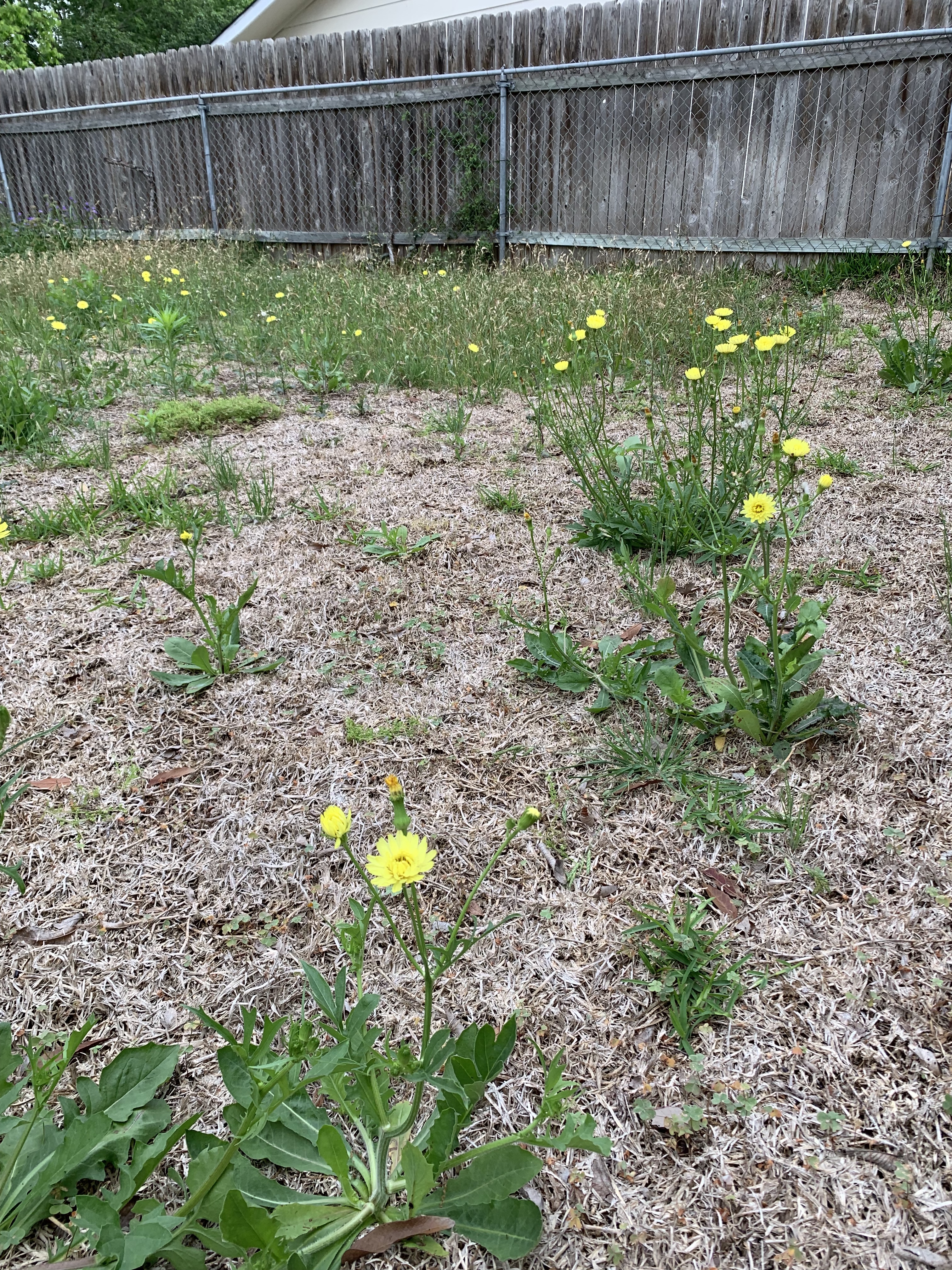
I’ll tell you more about yellow dock later. Today’s post is really about dandelions. Normal people are supposed to get rid of them. Would you stay at a lodging with a lawn that looked like this one above? If a business owner is this inattentive to the first thing a potential customer sees, what on earth might be inside? A dripping faucet? A cricket in the bed? If a customer pulls into the driveway and turns around and leaves, I can’t blame her. She doesn’t know that I loathe herbicide, that I’m no stranger to a dandelion digger, but that I’m very intentionally saving these dandelions, and not just for the honeybees.

Last year I read about dandelion syrup, also called mayhoney, though honey isn’t necessarily part of it. It is a European tradition (naturally, since that is where dandelions are from, after all). Dandelion syrup can be used as a sweetener, like other syrups and honey, and it can also be used medicinally as in cough syrup. But most of the recipes I read called for about a quart of dandelion petals, no green parts. The smallest recipe I could find required four cups of petals. That seemed like an awful lot of dandelions. I didn’t think I had enough, but I kept thinking about dandelion syrup all year, and never got around to doing anything about all those weeds. They’re one of Kiran’s favorite flowers, after all.

Well, not surprisingly, there are more of them this year, and that time has come around again. I hunted up a recipe for dandelion syrup today, and found one that could take as few as one hundred blossoms. Now, that would be easy. The kids and I gathered roughly 150 in a few minutes.

dandelion blossoms in a basket

Then I had to separate out the petals. Kiran loved caressing them.

dandelion petals

Our 150 blossoms yielded three and a half cups of petals, enough to double the recipe. The petals simmer and infuse overnight. They told me they wanted to be in the sun, so I’m putting them in a sun tea jar outside. Tomorrow I’ll strain, add sugar and lemon, and cook it all down to a syrup.

Next time you pull up to a motel, and you see what looks like an unkempt property, think of all those weeds as raw materials, medicines, and foods. It’s hard to partake of them and control them as well. That picture at the top of the page? I took it after we had harvested the 150 blossoms from that very spot. I couldn’t even see a difference. Kevin intends to mow them today, but of course we all know the bees will get their fill from the new blooms that pop open tomorrow.

And isn’t that exactly how it should be?

Ghost Poop

L-R: Toulouse, Rowan, Kevin, Kiran

L-R: Toulouse, Rowan, Kevin, Kiran

Me: It just wouldn’t cross anybody’s mind to put some clothes away, would it?

Kiran (age 5): It does, but it doesn’t get to the town of my mind.

Me: Passes through but doesn’t stick around, huh?

K: Yes. And it’s very sneaky and invisible.

Me: Mm hm.

K: So nobody sees it. . . etc. [My attention flagged at this point.] . . . etc. . . . and when ghost poop gets on a shoe, it turns green.

So there you have it.

Flint Hills Geology

I just came across this wonderful post on the geologic history of the Flint Hills.

Site Research Part 1: A Natural History of the Flint Hills

Don’t you just love geology? Oh, well, I suppose that’s another way that I’m odd. Take a look and see if you catch the bug.

Hamster Wheels

my kitchen

This is my kitchen. It is not worse than usual. I usually keep it hidden from public view. I haven’t invited someone into my home since last October, and it was ill-advised and won’t happen again. Why show you my kitchen? Why play so coy, when I could show you my dirty underwear instead?

My brain’s been running on hamster wheels all day, sometimes three at once. I do clean, it just never gets better. In recent weeks I’ve been working on this a lot, materially as well as mentally. I find a lot of resistance to the expectations of others, that I should be some ideal kind of person, keep a magazine-spread house, do the things those people do. Meanwhile I feel overwhelmed by the crap and I don’t even want to write, I need some space and some clarity and some quiet nothingness, which doesn’t happen in a room that looks like this.

I just read Marianne Williamson‘s Return to Love, about A Course In Miracles. It is a wonderful reminder to me that when I feel anything that is not joy, I am to pray for a change in perception, to miraculously know myself to be one with the Divine, whose dearest wish for me is perfect happiness. The shift I’ve been getting is that there is no one outside of myself who is holding expectations for me. I can’t even remember a time when someone expressed any thought about my lack of order. (Well, okay, it was my sister, and it happened last October, but sisters always have expectations for one another and we all ignore them, right?) What I’ve been rebelling against is nothing more than my own self-judgement.

I’m using all my new age hocus pocusey tools to change my thoughts from I can’t live up to your expectations and You expect too much it’s too hard I can’t do it I quit to I accept and love myself as I am or I access every imaginable resource for the fulfillment of my Divine purposes or both.

I was feeling pretty good about my perception-shifting this week, until I was reminded for the second time of the negative reviews posted about our motel on tripadvisor. Go ahead, look at them, then come back and look at the kitchen some more, but I’m not giving you the link. Our motel rooms are actually quite clean, in sharp contrast to the house, but when business and home and marriage are all tangled up together, well, everything’s tangled up together. My first thought was to ignore the reviews, like, for example, writers are supposed to do. It’s part of life. Just let it be.

But Kevin pointed out that there is a place on the site for responses, and thought we should take advantage of it. He’s right. It’s an opportunity to turn the situation around and demonstrate our professionalism and caring. So I had to think about what I wanted to say to those reviews, and the more I thought, the more annoyed I was. Clearly, at least in some of the complaints listed, the customer’s expectations were unrealistic. (Seriously, can you get someone to fix your cable TV service on a weekend? Do they do that in cities? We have one person who drives all over the state, and he gets here when he gets here.) Which brings us to that e-word. It turns out that some people do, in fact, hold expectations for me and my behavior, and those expectations are not within my ability to fulfill. Which means I have to start all over with my thought management. I don’t even know where to go from here.

Why can’t I just be a writer? Then I wouldn’t be obligated to respond to criticism, I’d be obligated to ignore it. I could be so much happier that way. I could just put out my best, and everyone could take it or leave it. I wouldn’t even have to refund their money if they complained. But I am so over my head with debts and commitments and bookkeeping, I’m stuck on this hamster wheel for the foreseeable future. There was a while when I dreamed of writing my way out, but I knew all along that was a fantasy.

I’d like your thoughts on one last question. When you check into a lodging, when do you expect to be asked to pay?


Melch Reads Les Miserables

S'pose if I'm serious about learning history, I should pick up one of these Will Durant ones.

S’pose if I’m serious about learning history, I should pick up one of these antique Will Durant print books.

It was my aim to learn about the French Restoration by reading Les Miserables. Turns out the book is chock-full of references to people and events, but no explanation of what any of them means. Guess next time I read this book I’ll get the annotated version, not the free one from the very admirable Project Gutenberg. But still, it’s quite a work, and I’m enjoying it a heckuva lot. Take these quotes:

This one shows an interesting view into Hugo’s ideal of womanhood.

She had always been predestined to gentleness; but faith, charity, hope, those three virtues which mildly warm the soul, had gradually elevated that gentleness to sanctity. Nature had made her a lamb, religion had made her an angel. Poor sainted virgin! Sweet memory which has vanished!

You should see this lady later, when she’s taking care of her blind brother.

Course Hugo never holds back from, well, anything, he pretty much says everything about everything, and in a lot of words, but in particular he never flinches from laying out his politics. In this quote, Jean Valjean has served twenty years of hard labor for stealing a loaf of bread to feed his hungry family (and later, trying to escape). He gets out and finds no one will give work or rent a room to a convict, and here he’s musing on his past.

Whether there had not been more abuse on the part of the law, in respect to the penalty, than there had been on the part of the culprit in respect to his fault. Whether there had not been an excess of weights in one balance of the scale, in the one which contains expiation. Whether the over-weight of the penalty was not equivalent to the annihilation of the crime, and did not result in reversing the situation, of replacing the fault of the delinquent by the fault of the repression, of converting the guilty man into the victim, and the debtor into the creditor, and of ranging the law definitely on the side of the man who had violated it.

And later,

He asked himself whether human society could have the right to force its members to suffer equally in one case for its own unreasonable lack of foresight, and in the other case for its pitiless foresight; and to seize a poor man forever between a defect and an excess, a default of work and an excess of punishment.

But there is another side.

The ingenuous police of the Restoration beheld the populace of Paris in too ‘rose-colored’ a light; it is not so much of an ‘amiable rabble’ as it is thought. The Parisian is to the Frenchman what the Athenian was to the Greek; no one sleeps more soundly than he, no one is more frankly frivolous and lazy than he, no one can better assume the air of forgetfulness; let him not be trusted nevertheless; he is ready for any sort of cool deed; but when there is glory at the end of it, he is worthy of admiration in every sort of fury. Give him a pike, he will produce the 10th of August; give him a gun, you will have Austerlitz. He is Napoleon’s stay and Danton’s resource. Is it a question of country, he enlists; is it a question of liberty, he tears up the pavements. Beware! his hair filled with wrath, is epic; his blouse drapes itself like the folds of a chlamys. Take care! he will make the first Rue Grenetat which comes to hand Caudine Forks. When the hour strikes, this man of the faubourgs will grow in stature; this little man will arise, and his gaze will be terrible, and his breath will become a tempest, and there will issue forth from that slender chest enough wind to disarrange the folds of the Alps. It is, thanks to the suburban man of Paris, that the Revolution, mixed with arms, conquers Europe. He sings; it is his delight. Proportion his song to his nature, and you will see! As long as he has for refrain nothing but la Carmagnole, he only overthrows Louis XVL; make him sing the Marseillaise, and he will free the world.

Here’s one more, just for fun. It’s not in vogue these days to speak of people as products of their social class, especially in America, but, strangely, it has a timeless quality, and calls to mind some modern people. Read it and see if if makes you think of anyone you know. (He’s talking about the infamous Monsieur and Madame Thenardier, petty scamming innkeepers.)

These beings belonged to that bastard class composed of coarse people who have been successful, and of intelligent people who have descended in the scale, which is between the class called ‘middle’ and the class denominated as ‘inferior,’ and which combines some of the defects of the second with nearly all the vices of the first, without possessing the generous impulse of the workingman nor the honest order of the bourgeois.

Don’t look at me, I’m just minding my own business, running my little motel out here in Kansas . . . .

Follow

Get every new post delivered to your Inbox.

Join 71 other followers